Numbers That Prove Our Commitment
Quality isn't a slogan — it's measured, tracked, and improved every single day.
23 Tests
Zero Defect
Target
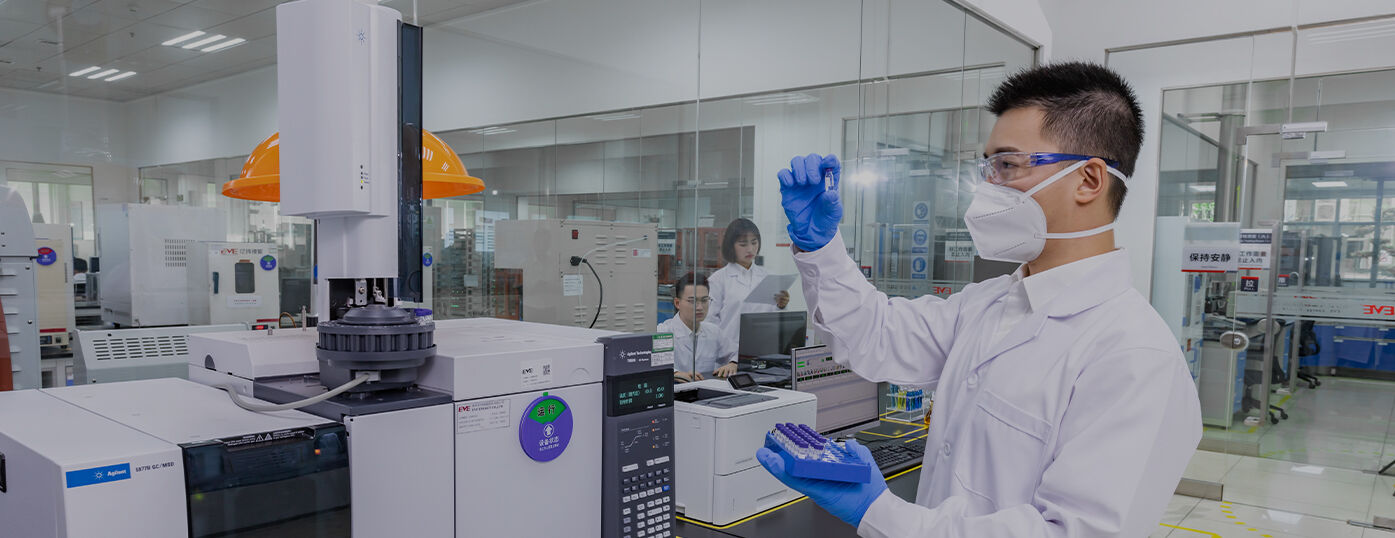 IQC · Incoming Inspection
 IPQC · In-Process Control
 FQC · Final Inspection
 OQC · Outgoing Inspection
 Test Laboratory
Four Quality Gates
From raw material to shipment — IQC (incoming) → IPQC (in-process) → FQC (final) → OQC (outgoing), under one IATF 16949 system with 6 Sigma methods.
IQC · Incoming Quality Control
Every batch of raw material is inspected before entering production. Only qualified materials move forward — no exceptions.
- Cathode material composition (EDXRF spectroscopy)
- Anode material particle size (laser granulometer)
- Electrolyte purity & moisture (Karl Fischer titration)
- Separator thickness & porosity
- Shell dimensions & surface defects
- GB/T 31485 · IEC 62133 · Customer specification sheets
- Supplier CoC cross-verification
- Quarantine → Review → Return or Scrap → 8D record
IPQC · In-Process Quality Control
Real-time monitoring of every critical-to-quality parameter throughout production. SPC charts trigger auto-alerts when any parameter drifts beyond control limits.
- Coating thickness uniformity
- Winding tension control
- Electrolyte fill volume (±0.05g precision)
- Formation voltage & current profiles
- Capacity grading accuracy
- SPC real-time monitoring · CPK ≥ 1.33
- Auto-alert on out-of-control conditions
- Key process 100% inline inspection
FQC · Final Quality Control
100% of finished cells and PACKs undergo full functional testing before release. No sampling — every single unit is verified.
- OCV (Open Circuit Voltage) & IR (Internal Resistance)
- Capacity grading & sorting
- BMS communication verification
- CCD visual inspection (surface defects)
- Charge/discharge cycle validation
- Capacity deviation < 3%
- IR deviation < specified tolerance
- Zero visual defects
OQC · Outgoing Quality Control
Final verification before shipment. Packaging integrity, documentation completeness, and batch traceability records are all confirmed.
- ANSI/ASQ Z1.4 sampling inspection
- Packaging integrity & labeling verification
- Documentation review (CoC, test reports)
- Batch traceability record completeness
- Quality manager sign-off required
- All records archived in MES system
Tested Beyond the Standards
Our test standards exceed GB/T 31485, IEC 62133, UL 1642, UN 38.3 and GB 31241 — including nail penetration and seawater immersion tests that most international standards do not require.
Electrical Performance
- Rated capacity
- Rate charge / discharge
- High & low temperature discharge
- Charge retention
Safety (Abuse)
- Overcharge
- Over-discharge
- External short circuit
- Drop
- Heating (130 °C)
- Crush
- Nail penetration
Environmental
- Temperature cycling (−40 °C to 85 °C)
- Low pressure (11.6 kPa)
- Seawater immersion
Mechanical
- Impact (heavy object)
- Vibration
Reliability
- Room-temperature cycling (100% DOD, 1,000+ cycles)
- High-temperature cycling (45 °C/60 °C)
- High-temperature storage
Extreme Safety
- Burning test
- Seawater immersion
- Nail penetration (beyond IEC/UL)
6 Sigma Quality Management Framework
Six proven methodologies applied across every stage of our quality system.
DMAIC
Define · Measure · Analyze · Improve · ControlStructured five-phase framework for solving complex quality problems. Every improvement project at PLB follows this data-driven cycle from problem definition to sustained control.
FMEA
Failure Mode & Effects AnalysisBefore any new product or process launches, we systematically identify every possible failure mode, assess its severity and likelihood, and implement preventive controls.
DOE
Design of ExperimentsScientific experimental design to find optimal process parameters with minimum trial runs. Used extensively in cell chemistry optimization and PACK thermal management design.
MSA
Measurement System AnalysisEnsures every measurement instrument — from voltage testers to capacity graders — delivers accurate, repeatable, and reproducible results before entering production use.
SPC
Statistical Process ControlReal-time statistical monitoring of every critical process parameter. Control charts trigger auto-alerts when any parameter drifts beyond control limits — before defects occur.
8D
Eight Disciplines Problem SolvingWhen a quality issue arises, our 8D process delivers a structured root cause analysis and permanent corrective action — typically within 24 hours of customer notification.
Three Interconnected Data Systems · One Connected Quality Network
Cell MES
Cell production data — process parameters, equipment and quality records captured for every cell.
PACK MES
PACK assembly data — every PACK carries a unique barcode linked to line, batch and quality records.
Cell BDM
Cell-level big-data records — every cell has a unique serial number traceable to line, batch, machine and raw-material batch.
Traceability in Action — From Customer Feedback to Root Cause
Scenario: A customer reports capacity degradation on a specific PACK batch in field application.
Start Your Custom Battery Project Today
Tell us your voltage, capacity and application — our engineers reply with a solution and quotation within 12 hours.
NDA available upon request · Typical response within 12 hours